Global Fraud Study: Why Cross-Border Data Sharing is Trapped in Silos

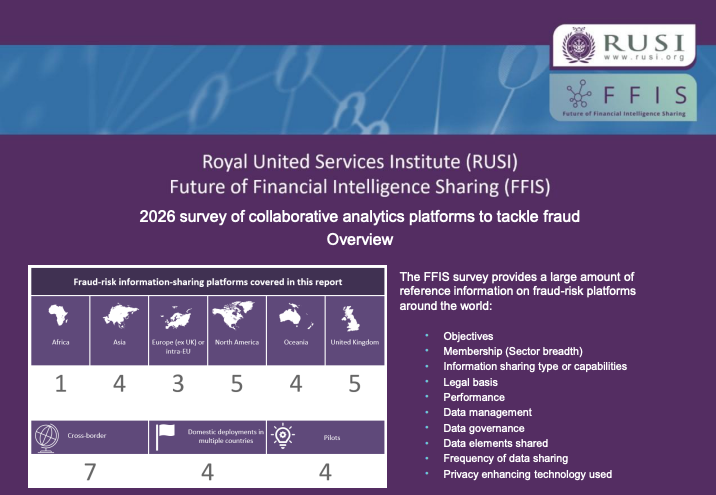
A new global study by the Future of Financial Intelligence Sharing (FFIS) research programme reveals that while 91% of anti-fraud leaders consider cross-border data sharing essential, a critical gap remains as most platforms continue to operate in isolated domestic silos. Released in May 2026 by Nick Maxwell of the Royal United Services Institute (RUSI), the comprehensive report surveys 37 collaborative analytics platforms battling a transnational fraud crisis that cost the global economy an estimated $579.4 billion in 2025. The rapid rise of real-time digital payments has accelerated an operational arms race, outpacing traditional, fragmented compliance frameworks and leaving financial networks highly exposed to sophisticated, multi-jurisdictional criminal syndicates.
A stark operational paradox defines the current landscape: platform leaders overwhelmingly view cross-border data sharing as vital to dismantling scam networks, yet actual international data integration remains remarkably low. Most anti-fraud utilities are strictly domestic in orientation due to a lack of standardized international frameworks, legal ambiguities across borders, and stringent local data localization requirements. Consequently, critical threat intelligence discovered by a platform in one jurisdiction rarely moves to protect communities in another, allowing fraudsters to freely exploit these structural silos to launder stolen funds globally.
Amid these disconnected systems, a diverse array of models—ranging from law-enforcement-led anti-scam centres to for-profit commercial data networks—are actively innovating to close the gap.
Within this collaborative ecosystem, the Global Signal Exchange (GSE) provides a highly collaborative technical template for how multi-party networks can bridge geographic and industry divides. Operating as a cross-border, non-profit collaboration platform, the GSE facilitates a broad, cross-sector approach that brings telecommunications, technology, and social media entities into shared dialogue alongside traditional financial institutions.
This multi-sector footprint addresses a critical vulnerability in the fraud kill chain. Report data indicates that telecom and tech companies often interact with victims days before a financial transaction occurs, making cross-sector early warning a paramount asset to breaking the lifecycle of a scam before the extraction of funds takes place.
While the GSE handles a diverse spectrum of intelligence to map operational connections, a key advantage highlighted in its approach is the integration of less sensitive data types. By utilising technical indicators like domains, URLs, and IP addresses, the platform achieves instant interoperability because every system connected to the internet can handle these data types without complex reformatting.
By scaling a central platform to host more than 1 billion threat signals from members worldwide, the GSE demonstrates how a flexible, privacy-preserving warning function can seamlessly complement the more targeted, case-based investigations of other regional networks.
To bridge these disparate systems, the paper explicitly recommends that the "FATF take a leadership role to establish the policy framework to enhance cross-border cooperation to tackle fraud and better connect national information-sharing platforms." Ultimately, the study highlights that integrating these scaled, cross-sector hubs is vital for those looking to "be part of a ‘network of networks’ to help respond to the fraud and scam threats we collectively face across borders."