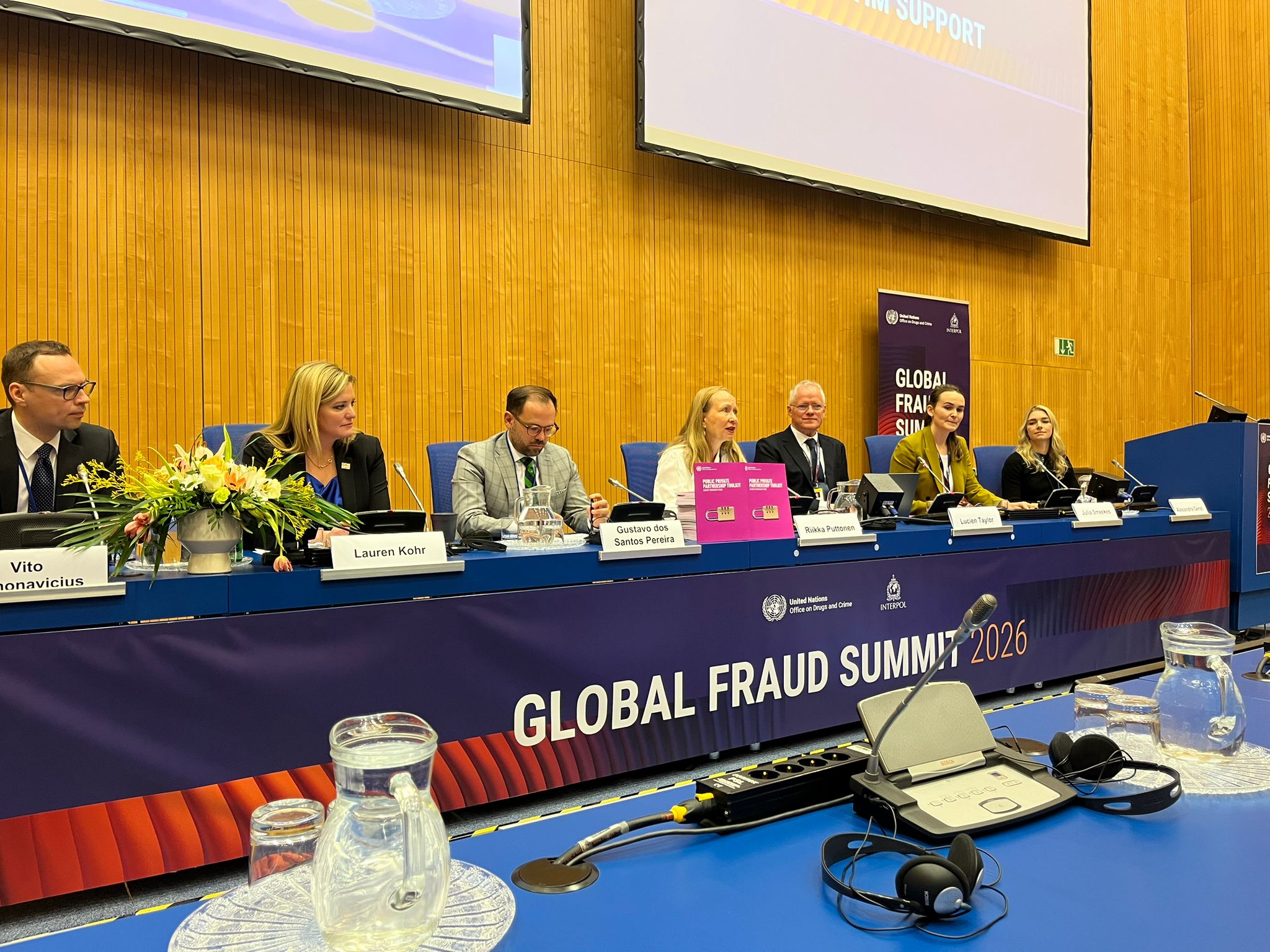
The UNODC Global Fraud Summit (16–17 March 2026) concluded with a shift toward operational unity, headlined by the Official Call to Action and an Industry Accord to Combat Scams and Fraud. Signed by tech leaders including Google, Meta, Amazon, and Microsoft, the accord establishes a formal commitment to real-time threat intelligence sharing to disrupt transnational criminal networks and explicitly identifies the Global Signal Exchange (GSE) as a platform for prevention.
The GSE’s practical impact was a focal point during several UNODC sessions, where Nick Sharp (UK) detailed the success of the Online Crime Centre Pilot. Sharp reported that the UK’s National Crime Agency shared over 1000 signals with Google via GSE. Within 24hrs, 4 URLs and 87 email accounts led to more than 5,000 scammer web domains and close to 50,000 fraudulent accounts being disrupted - and in just a few weeks the NCA made criminal referrals against over a dozen suspected scammers to local police in West Africa.
The summit also featured a panel co-organised by OXIL and NatWest, "Building a scam prevention ecosystem that actually works," which highlighted through a case study both effective ways of ‘breaking the spell’ to help banking customers understand that a proposed investment was fraudulent, and the ecosystem wide approach of mobilising fragments of intelligence through the GSE for effective outcomes. James Babbage from the UK NCA drew links to the new Online Crime Centre, set up under the UK Fraud Strategy, and the successful pilot with GSE.
During a UNODC lightning talk, Lucien Taylor (OXIL) noted that the GSE's value lies in its ability to convert fragmented data into a cohesive operational picture, stating it is time for a paradigm shift away from bilateral notice-and-takedown, to a proactive, ecosystem-wide response.
The Global Fraud Summit’s outcome documents align with the GSE’s architectural goals, particularly regarding harmonised cross-border reporting and the removal of legal barriers to data sharing.
Discussions frequently touched on the necessity of navigating EU adequacy decisions and privacy frameworks to ensure global enforcement can match the pace of criminal activity.
As a secure, centralised clearinghouse, the GSE supports the UNODC’s vision for a Global Public-Private Partnership Framework, enabling platforms to issue preemptive warnings and disable malicious actors before they reach potential victims.
Separately, OXIL’s latest research introduced a new safeguarding model based on large-scale AI analysis of 28.6 million signals collected through the GSE. The study challenges traditional assumptions about victimhood, using semantic analysis to identify how specific target groups and thematic lures are employed by scammers. This data-driven approach complements the operational successes cited by the UK, suggesting that future prevention must move from individual awareness to a collective safeguarding strategy.
Looking ahead, the momentum from Vienna provides a roadmap for scaling coordinated defences against fraud. With the Industry Accord providing a strategic framework, the focus now turns to expanding threat coverage across more regions. By integrating the UNODC's Call to Action into daily operations, the Global Signal Exchange aims to reduce fraud through real-time signal sharing across geographic borders, industry sectors and law enforcement.