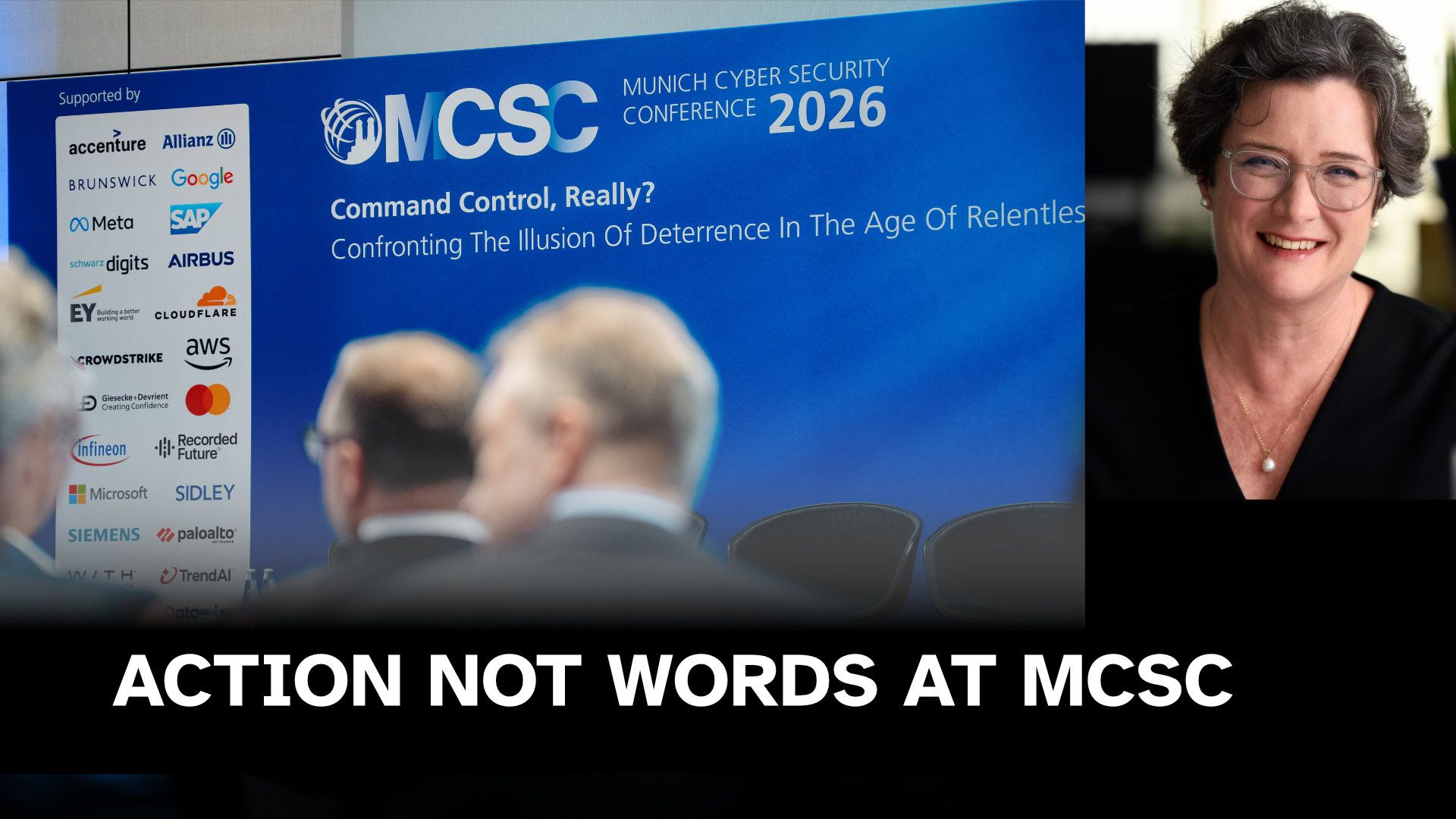
The Munich Chamber of Commerce hosted the annual Munich Cyber Security Conference on 12-13 February 2026, drawing hundreds of global delegates to navigate an increasingly complex digital landscape. While the main stage tackled the "big picture" of cyber warfare, space as an emerging domain of conflict, and the systemic risks of AI, a series of focused side events on cybercrime, held under the Chatham House Rule, provided a forum for more granular, results-oriented debate.
Among these, Lucien and Emily Taylor were invited to represent the Global Signal Exchange at two key sessions. The first, a roundtable co-organised by Trusted Future and the Center for European Policy Analysis (CEPA) titled “Less Talk, More Security,” focused on moving beyond theoretical cooperation towards tangible results. Here, the GSE was cited as an example of cybercrime cooperation in action—a practical counterpoint to the broader challenges affecting international cybersecurity diplomacy.
The theme of actionable partnership continued at a Meta-hosted roundtable, “Driving Global Collaboration to Counter Online Scams.” The discussion focused on the mechanics of industry-government partnerships and the necessity of regional coordination. Participants underscored a recurring reality: to be effective, threat signals must be shared across borders and sectors at a speed and scale that outpaces the fraudsters.
The discussions also tackled the evolving "geography" of the scam industry. While Meta’s recent Adversarial Threat Report provides a vital mapping of the physical scam compounds operating across Southeast Asia, the debate highlighted a complementary approach: focusing on the geography of supply chain vulnerabilities. By viewing the problem through this lens, participants noted that the GSE’s league tables offer a necessary layer of transparency, identifying the specific supply chain risks that bad actors exploit to facilitate their operations.